
Water Quality Data and Maps
Water quality in Ireland is continually monitored by the Environmental Protection Agency (EPA), local authorities, the Marine Institute, Waterways Ireland and many others, in order to better understand the ecological health of Ireland’s rivers, lakes, canals, groundwaters, estuaries and coastal waters. Standards and objectives are set out in the EU Water Framework Directive and also at national level in the River Basin Management Plan for Ireland.
Our rivers, lakes, estuaries, coastal and groundwaters are assessed under the EU Water Framework Directive. This EU law came into effect in December 2000. Having a single European framework to assess water quality allows us to compare our results across Europe.
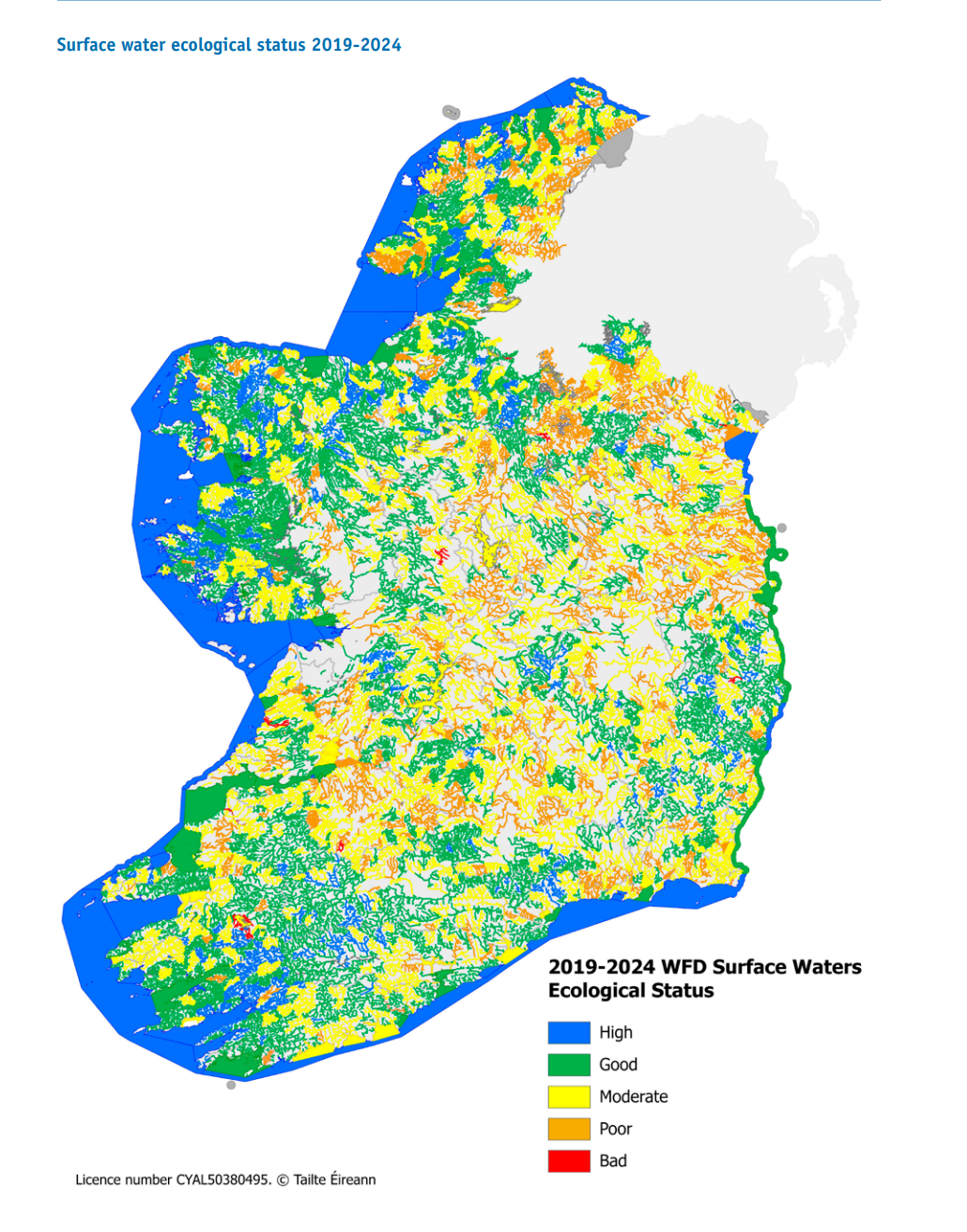
Our surface waters are classified into five quality classes or status under the Water Framework Directive:
- High – represented in blue on maps
- Good – represented in green on maps
- Moderate – represented in yellow on maps
- Poor – represented in orange on maps
- Bad – represented in red on maps
‘High’ is when the water is unpolluted, and ‘Bad’ is when the water is highly polluted.
Is Water Quality Improving or Declining?
In the EPA’s latest assessment, the number of water bodies in satisfactory condition (high or good status) across rivers, lakes, estuaries and canals declined since the last assessment, which covered the period 2016-2021. In contrast, coastal waters and groundwaters improved slightly over the assessment period.
Overall, there has been a net decline in our water quality. The slight decline reported in this assessment reflects the ongoing pattern of continuing declines in water quality seen since the first assessment of ecological status was undertaken in the period 2007-2009.
According to the latest assessment of biological and environmental data collected over the period 2019 to 2024 by the EPA, 52% of our surface waters are in satisfactory ecological health as they are achieving either good or high ecological status. The remaining 48% of the surface water bodies in Ireland are not as ecologically healthy or resilient as they should be. This represents a 2% decline when compared to the previous assessment period.
The EPA’s ‘Water Quality in Ireland 2019-2024‘ report provides the following information about the quality of our natural waters in Ireland:
- Rivers: There has been a 2% decline in the number of river water bodies in satisfactory condition.
- Lakes: There has been 0.5% decline in the number of lake water bodies in satisfactory condition. The majority of high and good ecological status lakes are found in the southwest, west and northwest of the country. The catchments with the highest percentage of lakes with unsatisfactory water quality are situated in the northeast.
- Estuaries: There has been 5% decline in the number of estuarine water bodies in satisfactory
condition. This decline is most evident in the south and south west of the country. - Coastal waters: There has been a 1% improvement in the number of coastal water bodies in satisfactory condition.
- High Status Objective or Blue Dot Waters: Only 42% of 402 water bodies which should be at high status are achieving that standard.
For more detailed water quality information at a national scale, catchment scale, sub-catchment scale and local authority scale, please click here. Information is provided on water quality status, risk, pressures and objectives. Trends from water quality assessments over a number of monitoring cycles can also be viewed, including for our high status waters.
For information on how we monitor and assess the health of our waters please see here.